If you’ve spent any time looking at your energy bills recently, you’ve probably asked yourself: "Is it time I just got a battery?"
It’s a question we get asked every single week at Herofix. Whether you’re in a stone cottage in the Sidlaws, a new build in Perth, or a farmhouse near Blairgowrie, the logic remains the same. You want to know if spending thousands of pounds on a big box for your wall will actually save you money in the long run.
At Herofix, we believe in the "They Ask, You Answer" approach. That means being brutally honest. We aren’t here to tell you that batteries are a magic bullet for everyone. For some, they are a financial no-brainer. For others, the payback period might be longer than you’re comfortable with.
In this guide, we’re going to break down the costs, the ROI, and why being in Perthshire or Tayside changes the math for home battery storage.
The Honest Cost: What are we actually talking about?
Let’s start with the elephant in the room: the price.
In 2026, a standard home battery system isn't cheap. While prices have stabilised, you are still looking at an investment.
- A 5kWh to 7kWh system: Usually costs between £3,500 and £5,000 installed.
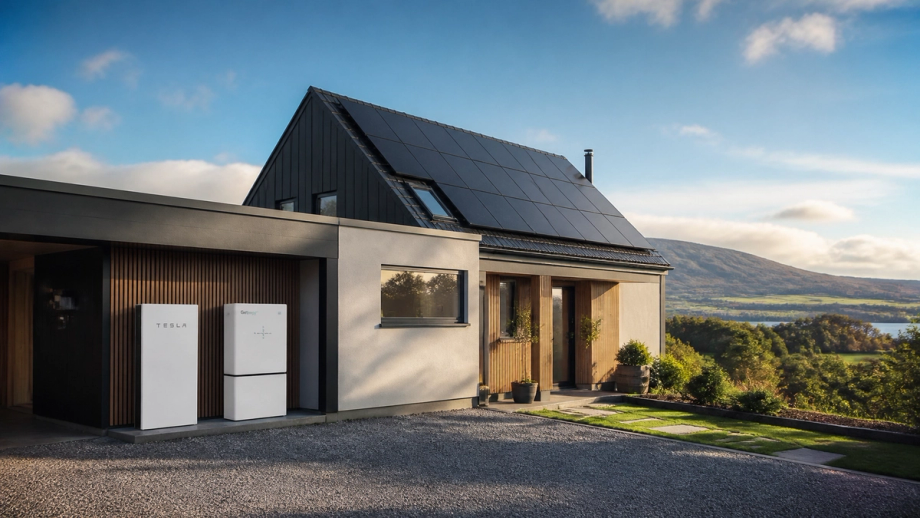
- A 10kWh to 13kWh system (like a Tesla Powerwall): Usually sits in the £7,000 to £9,000 range.
Why the range? It depends on where it’s being installed (is it a simple garage mount or a complex loft install?), the brand, and whether you are installing it alongside solar panels or as a standalone unit.
Is there a "Perthshire Premium"?
Not really. The equipment costs the same whether you’re in Dundee or London. However, because our local grid in parts of rural Perthshire and Tayside can be a bit... "sensitive" (more on that later), you might need specific backup gateways if you want your battery to keep the lights on during a power cut. That adds a bit to the installation cost.
The ROI: How long until it pays for itself?
This is where things get interesting for Scottish homeowners. In the South of England, solar panels do a lot of the heavy lifting. In Perthshire, we have slightly fewer sunlight hours, so we have to be smarter about how we use our batteries.
1. Solar Self-Consumption (The Sun Factor)
Without a battery, a typical home only uses about 30–40% of the energy their solar panels generate. The rest gets sent back to the grid for a measly export payment. With a battery, you can bump that up to 70% or 80%.
In Perthshire, where our winter days are short, a battery allows you to capture every scrap of low-lying winter sun and use it at 6:00 PM when the oven is on and the lights are up.
2. Grid Arbitrage (The "Buying Cheap" Factor)
This is the secret weapon for ROI in 2026. You don’t actually need solar panels for a battery to save you money.
By using smart tariffs (like Octopus Flux or Agile), your battery can "buy" electricity from the grid at 2:00 AM when it's incredibly cheap (sometimes as low as 7p–10p per kWh) and store it. Then, during the "peak" evening hours when the grid wants to charge you 35p per kWh, your house runs off the battery instead.
The Math:
If you shift 10kWh of usage from a 35p peak rate to a 10p off-peak rate, you save £2.50 a day. That’s over £900 a year in savings just by being clever with your timing.
The Payback Timeline
- Best Case Scenario: Solar + High Usage + Smart Tariff = 8–10 years.
- Average Scenario: Solar + Medium Usage = 12–15 years.
- Poor Scenario: No Solar + Low Usage + Flat Tariff = It might never fully pay for itself.
Our energy flow visualises how batteries bridge the gap between generation and consumption.
Why Perthshire Residents Care About More Than Just Money
If you live in a rural part of Tayside, you know that the grid isn't always reliable. Storms, fallen trees, or just "end of the line" infrastructure can lead to frequent flickers or full-blown outages.
For many of our customers in places like Comrie, Pitlochry, or the Carse of Gowrie, a battery is about Resilience.
Backup Power
A battery with a "backup" function acts like a giant UPS (Uninterruptible Power Supply) for your whole house. When the grid goes down, the battery kicks in within milliseconds. You might not even notice the lights flicker, but your fridge stays cold, your Wi-Fi stays on, and your heat pump or boiler controls keep the house warm.
For some homeowners, the peace of mind of knowing they won't be sitting in the dark is worth the investment alone, regardless of whether the ROI takes 8 years or 12.
Who is Battery Storage FOR?
A battery is likely a great investment for you if:
You already have solar panels (or are planning to get them).
You have high evening electricity use (cooking, electric showers, EV charging).
You are willing to switch to a smart/time-of-use tariff.
You live in a rural area prone to power cuts.
You plan on staying in your home for 10+ years.
Who is it NOT for?
We’ll be the first to tell you to hold off if:
You have very low electricity usage. If your bill is only £50 a month, a £7k battery will take decades to pay back.
You are on a fixed-rate flat tariff and have no intention of switching.
You are moving house in the next 2–3 years. You won't see the return on investment before you leave.
Your home is purely a summer holiday let.
Local Expertise: The Herofix Difference
Installing a battery in a modern villa in Dundee is one thing. Retrofitting one into a 150-year-old stone cottage in the Highlands is another. At Herofix, we specialise in Perthshire stone cottages and complex rural installs.
We don't just "fit a box." We look at your historical energy data, check your local grid constraints (DNO applications in Tayside can be tricky!), and recommend a system that actually matches your lifestyle.
The "Is it Worth It?" Verdict
In 2026, for the average Perthshire homeowner with solar panels, yes, it is worth it.
The combination of rising energy prices and the availability of smart tariffs means that batteries have moved from "expensive toy" to "essential home appliance." You get lower bills, a lower carbon footprint, and protection against the next big winter storm.
Ready to see the numbers for your own home?
The best way to know for sure is to get a bespoke calculation. We can look at your roof, your bills, and your goals to give you an honest "payback date."
Get a Quote from Herofix today
Want to learn more?
Check out our other guides for Tayside homeowners: