For many Perthshire businesses, solar panels can reduce reliance on grid electricity and make energy costs more predictable. But commercial solar is not simply a larger version of a home installation. Roof structure, electricity demand, three-phase supplies, grid connection rules, planning and tax all need to be considered.
This guide answers common questions from businesses, farms, estates, workshops, offices, shops, hotels, schools and community buildings in Perth, Scone, Crieff, Blairgowrie, Kinross, Auchterarder, Dunkeld, Aberfeldy, Pitlochry, the Carse of Gowrie and Highland Perthshire.
How does commercial solar work?
Solar photovoltaic (PV) panels convert daylight into electricity. An inverter then changes that electricity into the type your building can use.
The electricity is normally used in this order:
Your building uses the solar power.
A battery stores surplus electricity, if one is installed.
Remaining surplus may be exported to the grid.
The business imports electricity when solar generation is not enough.
The best financial result usually comes from using as much solar electricity as possible on site. This is known as self-consumption. Export payments can be useful, but exported electricity is often worth less than the electricity your business would otherwise buy.
A system for a daytime business may work well without a battery. A hotel, farm or workshop with evening demand may benefit from storage. The right design depends on your half-hourly electricity use, opening hours and future plans.
Is my business suitable for solar panels?
Potentially. Solar can work well for:
- Warehouses and industrial units
- Farm buildings and agricultural sheds
- Workshops and garages
- Offices and retail premises
- Hotels, visitor attractions and estates
- Schools and community buildings
- Cold stores, dairies and buildings with refrigeration
- Sites planning electric vehicle charging or heat pumps
A large roof is helpful, but it is not the only consideration. A survey should check roof orientation, shading, access, asbestos, roof condition, fire safety and the building’s electrical infrastructure.
Older stone buildings around Crieff, Dunkeld, Aberfeldy and Pitlochry can sometimes be suitable, but the age of the building does not prove whether the roof can carry a solar array. A structural assessment may be needed before installation.
Rooftop or ground-mounted solar: which is better?
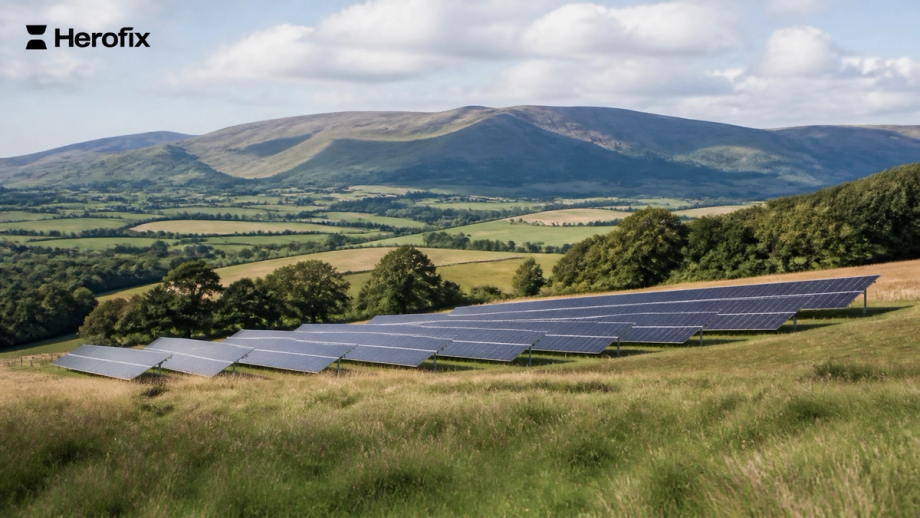
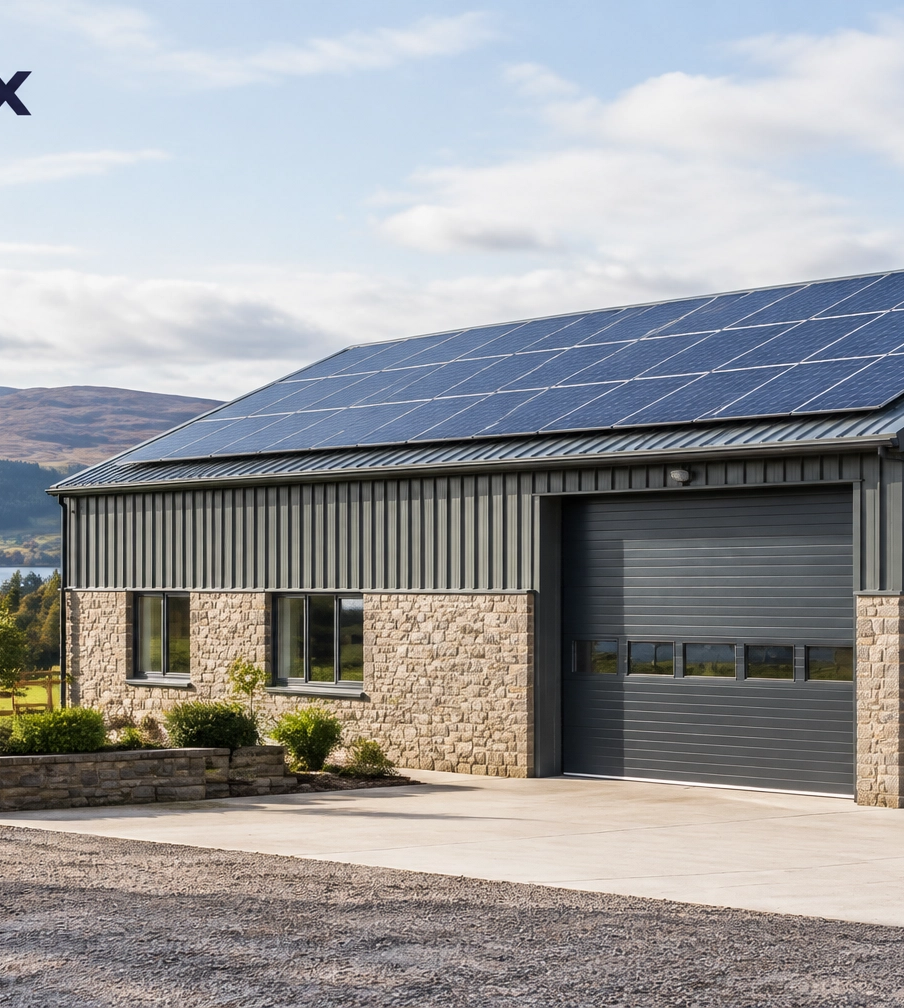
Rooftop solar is usually the first option for a business because it uses existing space and avoids taking up valuable land. It may also be simpler from a planning perspective, although restrictions can apply to listed buildings, conservation areas, sensitive landscapes and sites near aerodromes.
Ground-mounted solar can be useful where the roof is unsuitable or electricity demand is close to a field or yard. However, larger arrays normally require more planning work, a suitable location, cable routes and potentially a more complex grid connection.
In Scotland, the Scottish Government’s Circular 2/2024 on non-domestic permitted development rights covers relevant rules, including Class 6J for solar attached to non-domestic buildings and Class 6N for some free-standing installations.
A commercial rooftop system serving one business is not the same as a utility-scale solar farm. A solar farm involves larger land areas, different planning considerations, landscape impacts, ecology, highways and grid infrastructure. You can read more about the distinction in Herofix’s guide to solar farms in Perthshire.
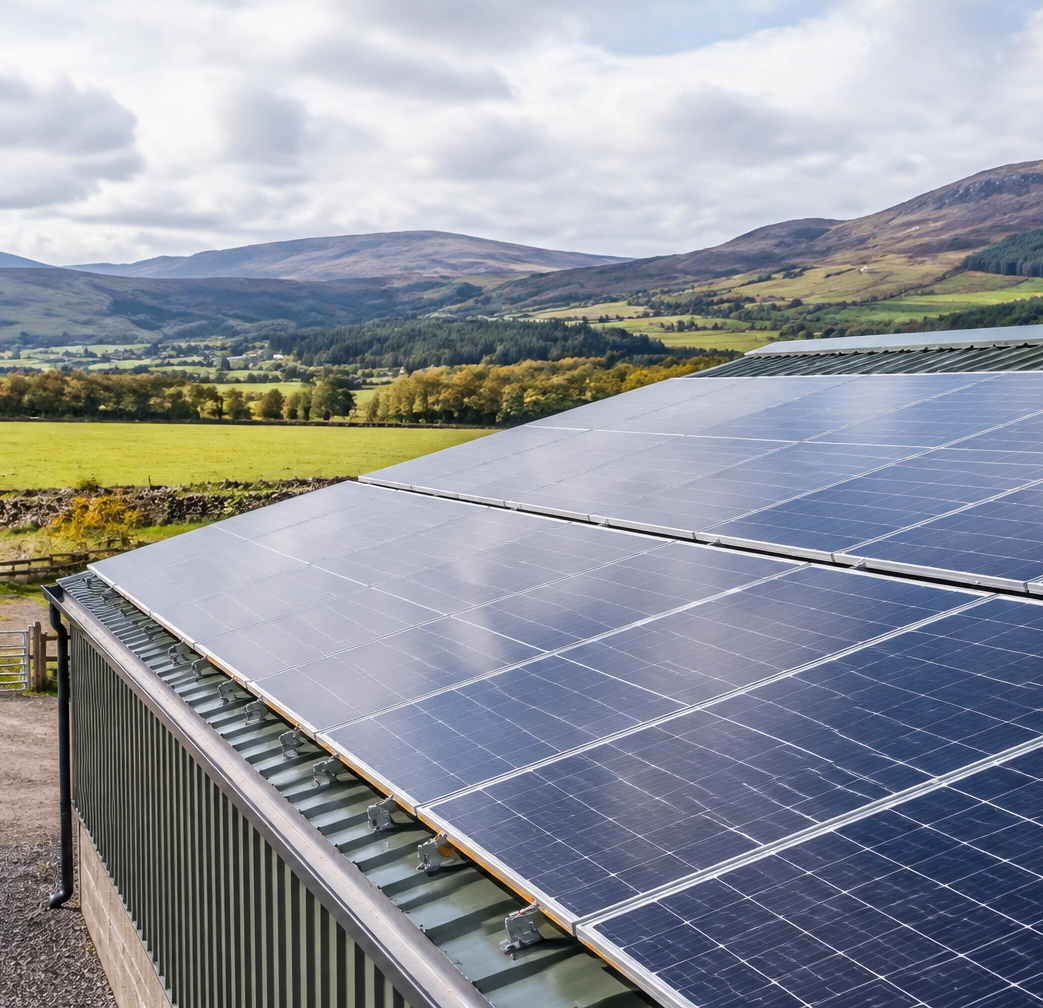
Can a warehouse or farm roof support solar panels?
Sometimes, but this must be checked rather than assumed.
A commercial solar array adds dead load to the roof. The total weight depends on the panels, mounting system, ballast, fixings and other equipment. Wind and snow loading also matter, particularly for exposed rural sites.
A proper survey should consider:
- Roof structure and span
- Existing damage, leaks or corrosion
- Roof covering and remaining service life
- Trusses, purlins and load-bearing points
- Wind exposure and local conditions
- Panel layout and access routes
- Whether roof repairs should happen first
Do not install solar on a roof that may need replacement soon. Removing and reinstalling an array later can add cost and downtime.
Do commercial buildings need a three-phase supply?
Many larger premises use a three-phase electricity supply. This is common in workshops, farms, hotels, factories and commercial units with motors or machinery.
A three-phase supply can make it easier to connect a larger inverter and distribute generation across the building. It does not automatically mean that any system size can be installed. The installer still needs to assess your incoming supply, switchgear, protection, export capacity and the local distribution network.
Most meaningful commercial systems will need a grid connection application. The installer should explain whether the project falls under G98 or G99. In general, fully type-tested generation up to 16 amps per phase may use G98 procedures, while larger or different systems usually require G99 approval through the Distribution Network Operator (DNO).
The Energy Networks Association guidance explains the connection framework. Do not assume that a system can be switched on before DNO approval.
Should I add a commercial solar battery?
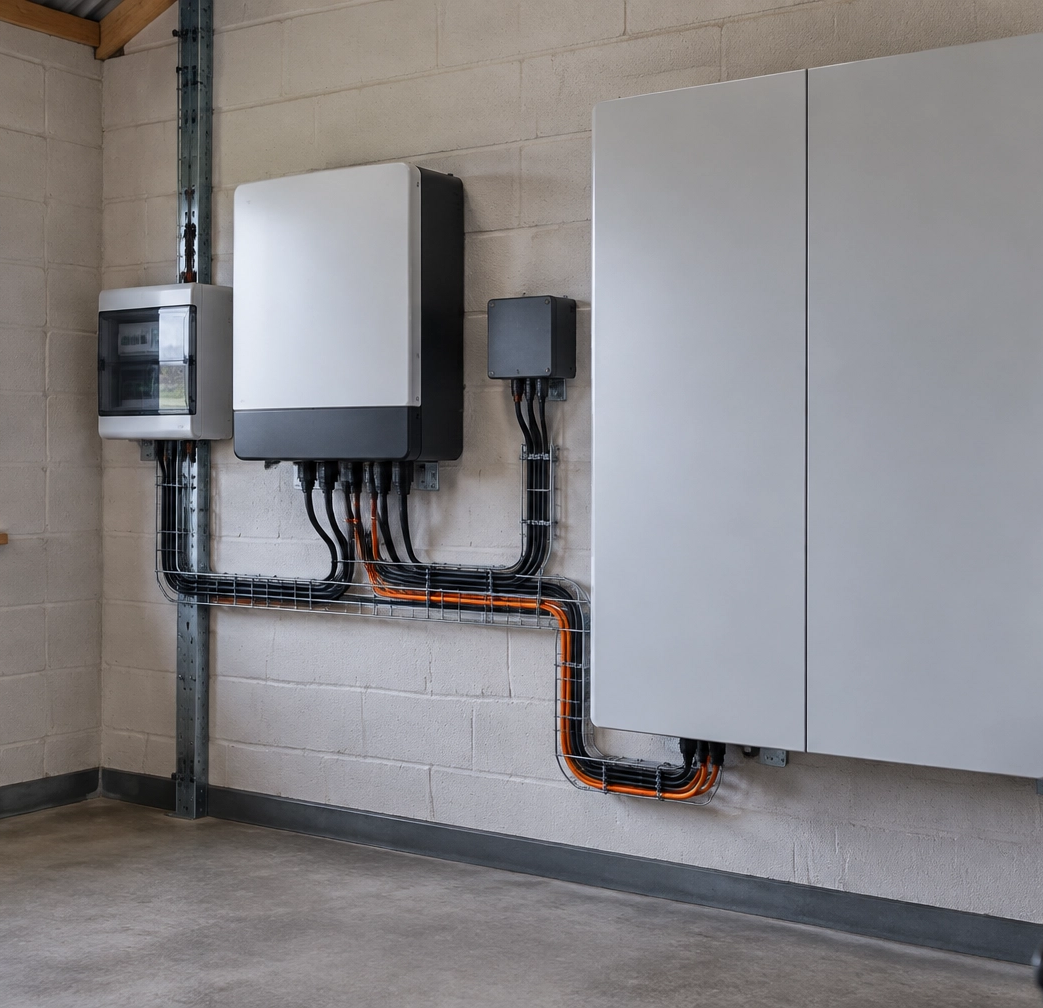
A battery can store surplus solar electricity and release it later. This may help a business that uses more electricity outside daylight hours.
Battery storage can support:
- Evening and early-morning demand
- Refrigeration and other consistent loads
- Peak demand reduction
- Greater solar self-consumption
- Limited backup for selected circuits, if designed for backup operation
A standard battery is not automatically an uninterruptible power supply. If your business needs equipment to keep running during a power cut, the system must be specifically designed with suitable changeover equipment and backup circuits. It may not be practical or cost-effective to back up an entire hotel, workshop or farm.
What happens to surplus electricity?
Surplus electricity can be exported to the grid, subject to the agreed connection.
A business may be able to receive payments through the Smart Export Guarantee, although eligibility depends on the system, capacity, metering and certification. For many smaller solar PV systems, MCS certification or an accepted equivalent is important.
Export income should not be the main assumption in a payback calculation. A robust quote should show:
- Expected annual generation
- Estimated on-site consumption
- Imported electricity displaced
- Export volume and assumed tariff
- Battery charging and discharge assumptions
- Degradation and maintenance costs
- Any export limit imposed by the DNO
Do commercial solar panels need planning permission?
Not always. Rooftop solar on a standard commercial building may benefit from permitted development rights, but the site still needs checking.
Planning permission or additional consent may be required for:
- Listed buildings or their curtilage
- Conservation areas
- National Parks or National Scenic Areas
- World Heritage Sites
- Historic gardens and designed landscapes
- Larger ground-mounted arrays
- Sites close to an aerodrome or technical site
- Solar farms or projects outside a building’s normal curtilage
Planning rules can be site-specific. A business in the Carse of Gowrie may face different considerations from one in central Perth, while an estate near Highland Perthshire may need particular attention to landscape and heritage matters.
What are the VAT, tax and grant rules?
Rules change, so your accountant should check the position before you commit.
For ordinary commercial premises, solar installation is generally subject to 20% VAT. A VAT-registered business may be able to reclaim VAT as input tax, subject to its own circumstances. The 0% energy-saving materials rate generally relates to qualifying residential accommodation and certain buildings used solely for relevant charitable purposes, not ordinary offices, farms, shops or workshops. See HMRC VAT Notice 708/6.
Businesses may also be able to claim capital allowances. The Annual Investment Allowance can provide 100% relief on qualifying plant and machinery expenditure up to the applicable limit. Check the current rules with your accountant, particularly if your business is part of a group or the project is financed.
There is no universal UK grant for every business solar installation. Funding can be sector-specific, region-specific or time-limited. Check current information through Herofix’s available grants page, your local authority and relevant Scottish business support organisations. Treat claims about “free commercial solar” or guaranteed grants with caution.
How should I assess solar panel ROI?
There is no reliable single payback figure for every Perthshire business. A system’s return depends on its price, electricity tariff, operating hours, roof, generation, self-consumption, export arrangements, finance cost and maintenance.
Ask for a model based on your own data, ideally including 12 months of half-hourly electricity use. Compare:
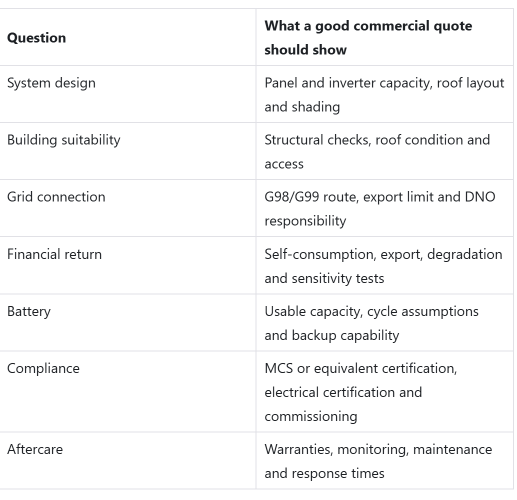
A quote showing only “annual savings” or a guaranteed payback is not enough. Ask what happens if electricity prices fall, generation is lower than forecast or the DNO limits exports.
What happens during a commercial site survey?
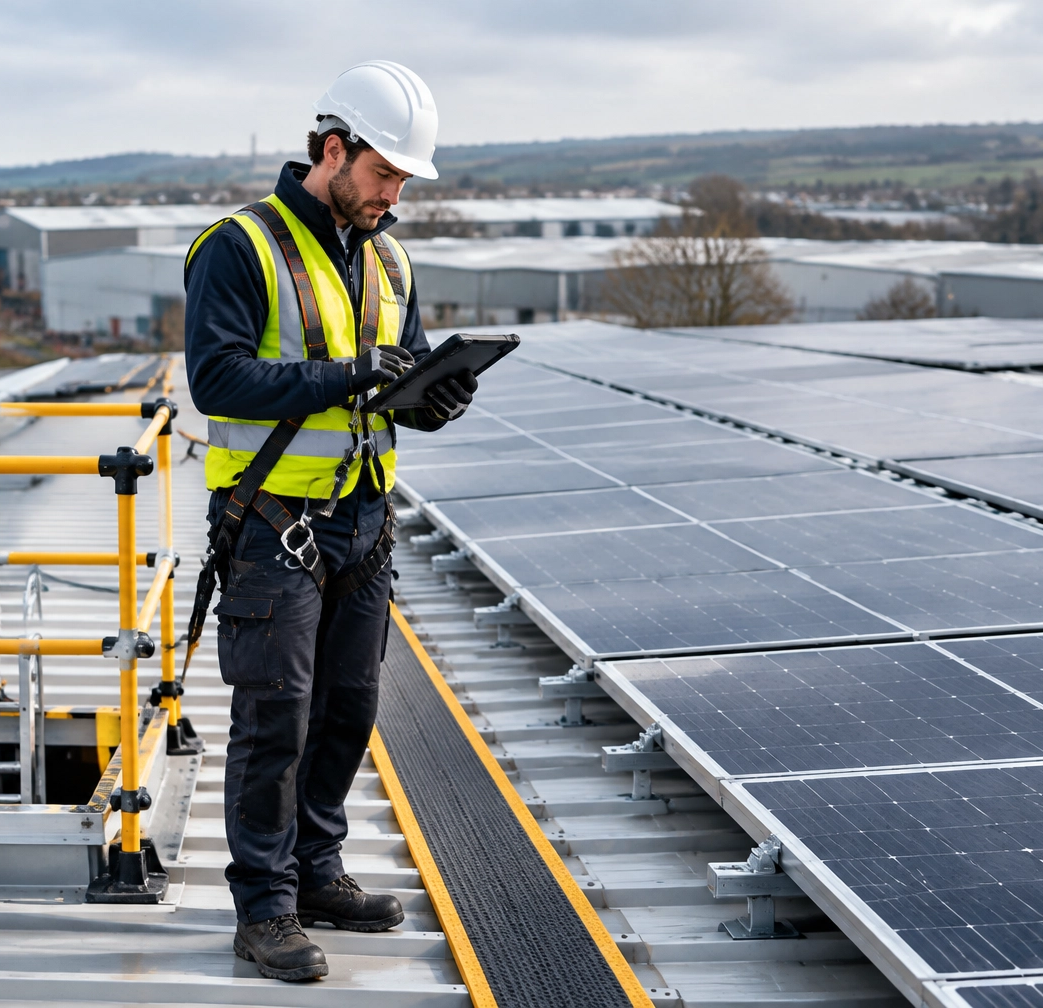
A survey should cover the roof, electrical system, energy use and practical installation requirements. The installer may need access to the main distribution board, meter, roof, plant rooms and proposed cable routes.
They should discuss working hours, scaffolding, lifting equipment, fire access, isolation procedures and how the installation will avoid disrupting trading. A professional installer should explain how downtime will be managed and whether any shutdown is required.
What should I ask a commercial solar installer?
Before choosing a commercial solar installer, ask:
- Have you completed projects of a similar size and type?
- Who handles the DNO application and G99 process?
- Will the roof and structure be assessed?
- What certification will I receive?
- Are the warranties from the manufacturer or installer?
- What is covered if the system underperforms?
- How is monitoring provided?
- What maintenance is recommended?
- What happens if the roof needs work later?
- Are VAT, finance, grants and tax assumptions clearly separated?
- Can you provide references for businesses or farms in Perthshire?
Herofix provides solar, battery and other energy solutions for businesses. You can contact Herofix for a commercial quote or explore its commercial services.
Commercial solar FAQs
Are commercial solar panels worth it in Scotland?
They can be, particularly where a business uses substantial electricity during daylight hours. The answer depends on the roof, electricity demand, installation cost, grid connection and how much power is used on site.
Can I put solar panels on a farm building?
Often, yes, subject to roof condition, structural capacity, electrical design, planning and grid connection. Agricultural buildings with daytime loads can be good candidates, but asbestos and older roof structures need careful assessment.
Do commercial solar panels need G99?
Many do. G99 normally applies where generation exceeds the G98 micro-generator threshold or does not meet G98 requirements. The installer should confirm the correct DNO route before installation.
Can commercial solar panels provide backup power?
Only if the system includes suitable battery storage, controls, changeover equipment and backup circuits. Standard grid-connected solar switches off during a power cut for safety.
Are there solar grants for businesses in Perthshire?
There is no single grant available to every business. Schemes change and may be limited by sector, location, size or funding period. Check current official guidance before relying on grant income.
Is a solar farm the same as solar for a business?
No. A rooftop or small ground-mounted system is normally designed to supply one business. A utility-scale solar farm is a much larger land and grid project with different planning, environmental and infrastructure requirements.