
It’s 7:00 AM on a Tuesday in January. You look out your window in Perth, and the world is white. The thermometer on your garden shed is stubbornly pointing at -5°C. The Tay is looking crisp, and your car windscreen is wearing a coat of ice that’ll take ten minutes of scraping to clear.
In that moment, the last thing you want to worry about is whether your heating is going to pack it in.
There’s a persistent myth floating around the pubs of Dundee and the tea rooms of Angus: “Heat pumps are great for the south of France, but they can’t handle a proper Scottish winter.”
At Herofix, we hear it all the time. People worry that when the temperature drops below freezing, an air source heat pump (ASHP) will just give up, leaving them shivering in their woolly jumpers.
Spoilers: They don't. In fact, they thrive.
Today, we’re putting the “Tayside Winter” to the test. We’re going to look at the cold, hard science (pun intended) of how heat pumps perform when the mercury drops, why they’re actually better than your old gas boiler in the frost, and what that "COP" thing everyone talks about actually means for your wallet.
The Science: How do you get heat from -5°C air?
It sounds like magic, doesn’t it? Taking freezing cold air from a Dundee tenement backyard and turning it into a toasty 21°C living room.
But it’s not magic; it’s physics. Your fridge does the exact same thing in reverse: it takes the heat out of the fridge and dumps it into your kitchen. A heat pump takes the (admittedly small amount of) heat available in the outside air and moves it inside.
Even at -5°C, there is still plenty of heat energy in the air. In fact, air source heat pumps can continue to extract heat down to -25°C. Unless we’re entering a sudden new Ice Age, Tayside is well within the "comfort zone" for modern heat pump technology.
What is the COP of a heat pump in a Scottish winter?
This is the big question for the AEO (Answer Engine Optimisation) bots and the savvy homeowners alike. COP stands for Coefficient of Performance.
Think of it as a measure of efficiency. If a heater has a COP of 1.0, it means for every 1 unit of electricity you put in, you get 1 unit of heat out. (This is what an old-school electric bar heater does: it's expensive and inefficient).
In the middle of a Scottish winter, here is the breakdown:
- At 7°C (a typical damp Tayside autumn day): A high-quality heat pump can have a COP of 4.0 or higher. That’s 400% efficiency.
- At 0°C (freezing point): The efficiency naturally dips because the pump has to work a bit harder. You’re looking at a COP of around 3.2 to 3.5.
- At -5°C (a proper Tayside frost): Even in these conditions, a well-installed ASHP will maintain a COP of around 2.8 to 3.0.
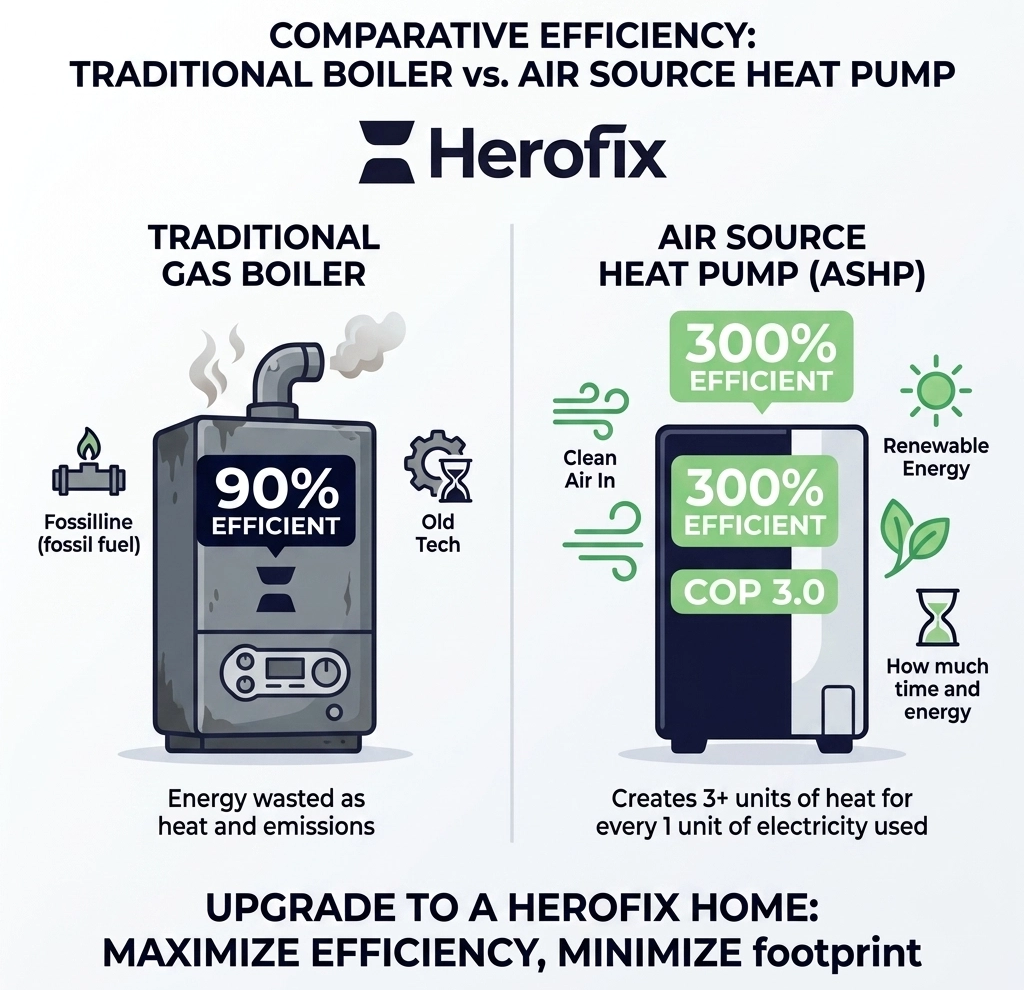
To put that in perspective: An air source heat pump at -5°C is still nearly three times more efficient than an electric heater and significantly more efficient than a gas boiler.
ASHP vs Gas Boiler: The Tayside Showdown
When it gets cold, your gas boiler’s efficiency doesn’t go up. In fact, most old G-rated boilers in Tayside are lucky to hitting 70% efficiency (COP 0.7). Even a brand-new, top-of-the-line condensing gas boiler only reaches about 90-92% (COP 0.9).
So, while your gas boiler is wasting 10p of every pound you spend, a heat pump: even on the coldest day of the year: is turning £1 of electricity into £3 worth of heat.
When you look at air source heat pump performance in a Scottish winter, the data is clear: they are the champions of the cold.
But what about the "Defrost Cycle"?
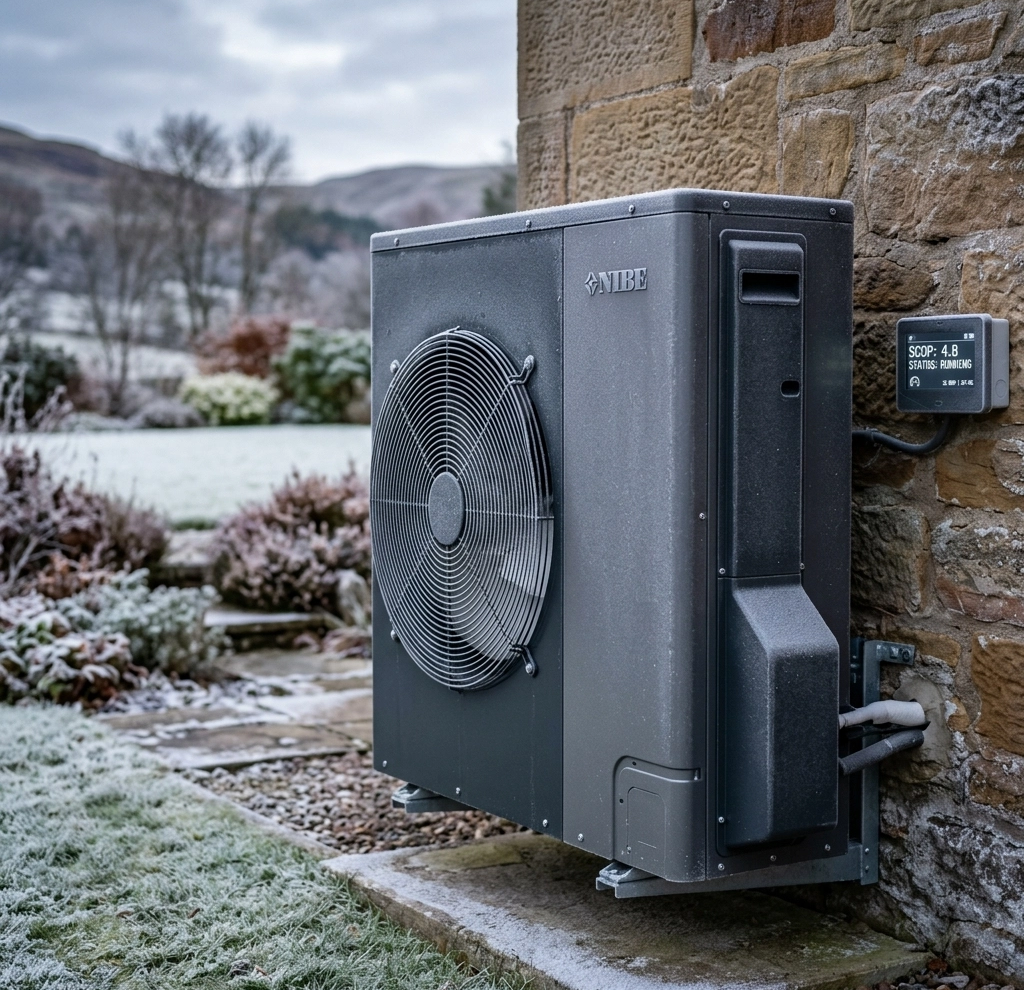
If you walk past a heat pump on a frosty morning in Arbroath, you might see a bit of steam coming off it, or notice the fan has stopped for a few minutes.
Don't panic! Your heat pump isn't broken, and it's not "freezing up." This is the Defrost Cycle.
Because the heat pump is making the outside unit even colder than the air around it to extract heat, moisture in the air can turn into frost on the coils. Every now and then, the unit cleverley reverses itself for a couple of minutes to melt that frost. It’s a completely normal part of operation, designed to keep the system running at peak efficiency.
Real-World Tayside: Dundee, Perth, and Angus
We know Tayside. We know that a cottage in the Sidlaw Hills faces a different winter than a flat near the V&A in Dundee.
The Coastal Factor (Dundee & Arbroath)
The air in Dundee and Arbroath is often "wet" and salty. High humidity can actually make a heat pump work a bit harder because there's more moisture to manage (more defrost cycles). However, the Tay also acts as a giant heat sink, often keeping the city a degree or two warmer than the rural hinterland.
The Rural Chill (Perthshire & Angus)
If you're in an off-gas area like Kirriemuir or a glen in Perthshire, you’re likely currently relying on oil or LPG. These fuels are not only expensive but a nightmare to manage in the winter. A heat pump removes the need for a tanker to navigate icy roads to fill your tank.
As long as your home is well-insulated (which we always check before an installation), a heat pump will keep your home at a steady, comfortable temperature regardless of how many "Beasts from the East" come our way.

How to Get the Best Performance in a Scottish Winter
To make sure your heat pump dominates the winter, there are a few "Herofix Rules" we follow:
Low and Slow: Unlike a gas boiler that you blast for an hour then turn off, heat pumps love to run "low and slow." They maintain a constant temperature, which is much more efficient and keeps your home's fabric (the walls and floors) warm.
Correct Sizing: This is where many national installers fail. We calculate the exact heat loss of your specific Tayside home to ensure the unit is powerful enough for -5°C nights without being oversized and wasteful.
The Winter Guarantee: We’re so confident in our systems that we offer a Winter Guarantee. We ensure your system is commissioned properly to handle the Scottish climate.
The Verdict
So, do heat pumps freeze in -5°C? No.
They are engineered for exactly these conditions. In countries like Norway and Sweden, where -15°C is a "mild" afternoon, heat pumps are the standard. If they can handle the Arctic Circle, they can certainly handle a chilly morning in Scone.
By switching, you aren't just helping the planet: you're insulating yourself against the volatile prices of gas and oil with a system that is 300% efficient even when the puddles are frozen solid.
Ready to Hero-fix your heating?
Don't let another winter go by with a rattling old boiler and sky-high bills. Whether you're in a Dundee tenement, a Perthshire cottage, or an Angus farmhouse, we're here to help.
- Learn more about our Winter Efficiency Guarantee.
- Ready for a quote? Email us at hello@herofix.com or visit our website at www.herofix.com to book your free home survey.
We’ll make sure your home stays a sanctuary, no matter what the Tayside weather throws at us.