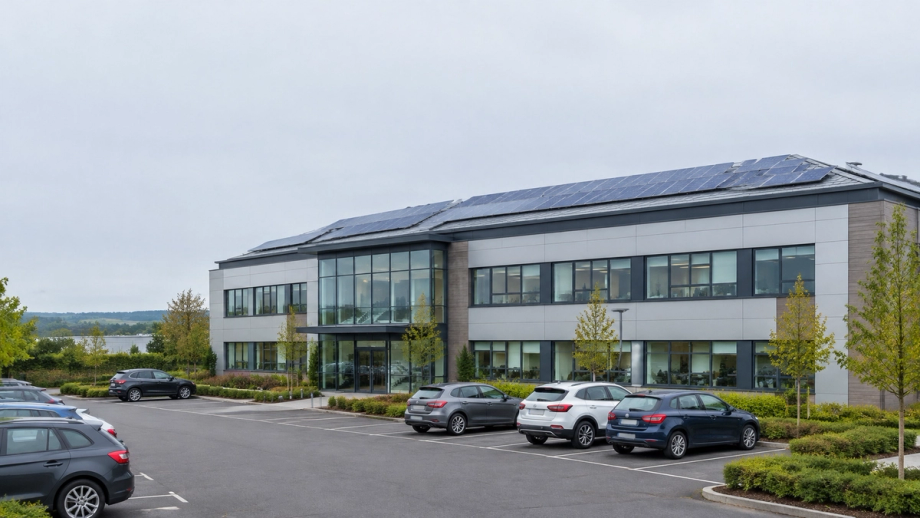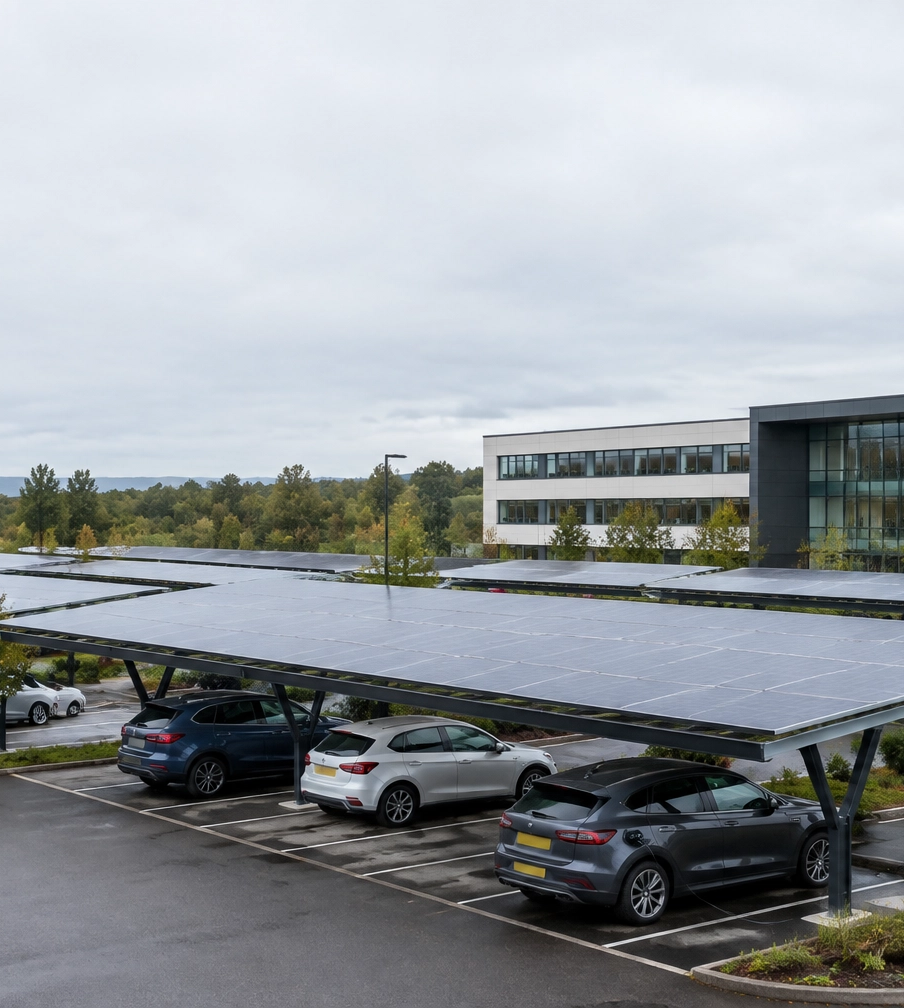
This is an independent look at a project Aviva announced in 2020. Herofix was not involved.
Who Aviva are
Aviva is an international insurer and asset manager. Its Perth office at Pitheavlis is the company’s Scottish headquarters and houses its property claims centre of excellence for commercial and personal property. When the project was announced on 16 November 2020, Aviva said it employed around 2,000 people in Scotland, with approximately 1,000 based at the Perth office.
The company has also described a wider climate commitment: it became the first carbon-neutral international insurer in 2006 and is a member of the UN Net Zero Asset Owner’s Alliance, with a commitment to net-zero emissions in its investments by 2050. Aviva also has a solar carport at its Norwich office.
The Perth project was opened ahead of COP26 as one of the UK’s largest combined solar carport and energy storage facilities. Its scale makes it an interesting example for commercial property owners considering what their own sites might support.
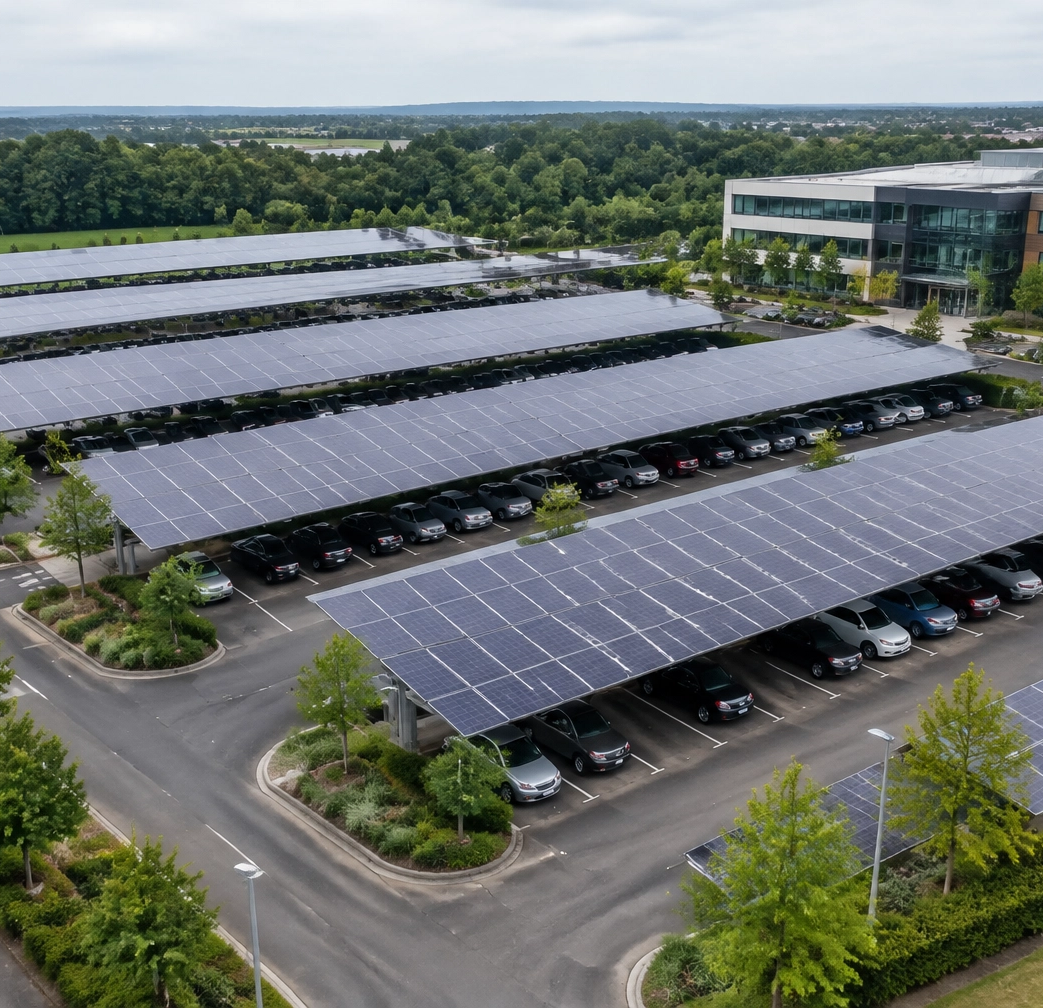
Illustrative image, not Aviva’s Perth site. The figures in this article are from the company’s 2020 announcement, not a statement of current performance.
Why a solar carport made sense in Perth
A car park can be a large area of hard-standing that does little beyond accommodating vehicles. A solar canopy makes that space work harder: panels generate electricity above the bays, while the structure provides shelter for parked cars.
The Perth installation covers 342 parking spaces and includes 50 electric vehicle charging stations. That brings generation, charging and storage together in one place. During the working day, when staff cars are parked for hours, some of the electricity produced can be used on site or directed to vehicle charging.
Aviva said in 2020 that it expected the system to generate 812,000 kWh of electricity a year: enough, by its estimate, to power more than 500 homes annually. The company said it would use 77% of the generation, with surplus electricity going to the battery for later use or being exported to the grid. A large office, with around 1,000 people based there, has a substantial daytime demand from functions such as IT, lighting, catering and ventilation. That helps explain why on-site use was part of the project’s design.
Storage was another important component. The site’s 1.8 MWh battery, powered by Tesla Powerpack technology, was intended to manage electricity flows between the panels, the office, the grid and the chargers. Aviva said the Perth office could operate off-grid for five hours each day when the national grid was at its busiest. That was a capability described in the 2020 announcement, not a claim about the site’s current operation.
The company also projected annual carbon savings of nearly 400 tonnes. The scheme received £1.5 million of support through the Scottish Government’s Low Carbon Infrastructure Transition Programme (LCITP). That funding is an important part of the project’s story, but it should not be taken to mean that every business can expect similar grant support.
There was a local supply-chain dimension too: Aviva said all manufacturing for the project was completed in the UK, using 100% recycled steel from the North of England, and that more than 60% of construction and ongoing maintenance was completed by Scottish workers.
What the job involved
Aviva said the system was designed and installed by RenEnergy. The public announcement gives the headline specifications, rather than a detailed construction log. The following describes what a comparable commercial carport scheme generally has to address; it is not a claim about the specific works carried out at Pitheavlis.
First, a carport is a construction project as well as an electrical installation. It requires engineered foundations and footings, steel frames designed for wind and snow loading, and a plan for managing rainwater. The structure must work with the site’s layout and ground conditions while preserving practical access for people and vehicles.
Construction also has to be planned around a live car park. Closing bays in stages can help keep a site operating, but it requires careful phasing, clear access routes and coordination with the building’s usual activities.
Then there is the electrical design. EV charging adds a significant load, so chargers need to be managed alongside solar generation, battery storage and the building’s own demand. A battery system of this kind also needs suitable siting, ventilation, fire-safety measures and access for maintenance. Monitoring and control equipment coordinates electricity flows between the panels, building, grid, battery and chargers.
A project on this scale would also need approval from the local electricity network operator. It would be far above the G98 threshold of 16 A per phase (3.68 kW on a single phase), so a comparable installation would require G99 approval.
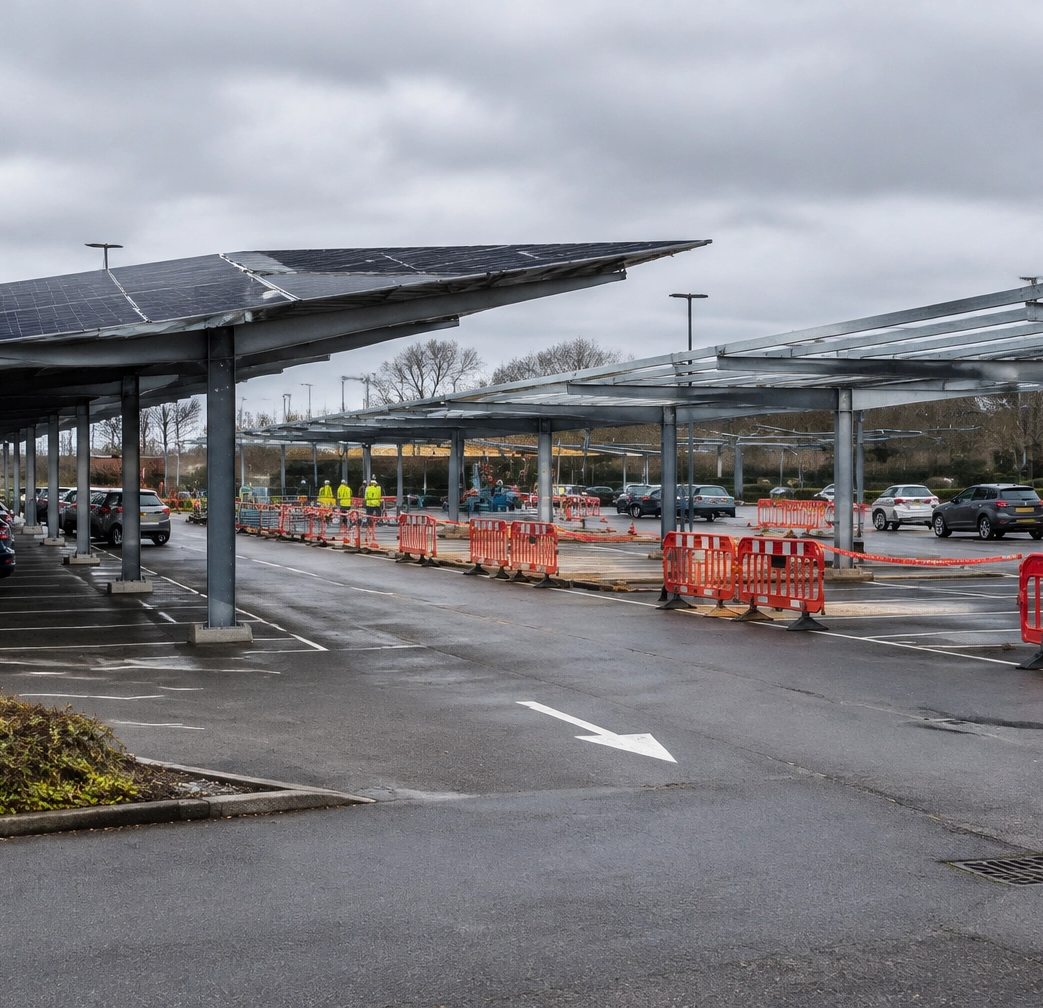
Illustrative image: a carport build needs careful planning to manage construction around a working car park.
Planning rules: what has changed since Aviva’s project
Aviva’s Perth scheme predates Scotland’s 2024 changes to permitted development rights. Under the current rules, solar canopies over qualifying parking areas are covered by Class 9M, rather than the rooftop solar provisions of Class 6J. This does not mean every proposed carport automatically qualifies.
Among the conditions, a canopy must be no more than four metres high, must be at least five metres from a road, and must not be in specified protected locations. These include conservation areas, National Parks, National Scenic Areas, World Heritage Sites and the curtilage of a listed building. Battery storage associated with a canopy is also subject to conditions, including a prior-notification process.
Owners should check the current rules and site constraints with their planning authority and design team before proceeding. The Scottish Government’s guidance on solar canopies and related equipment explains the Class 9M provisions.
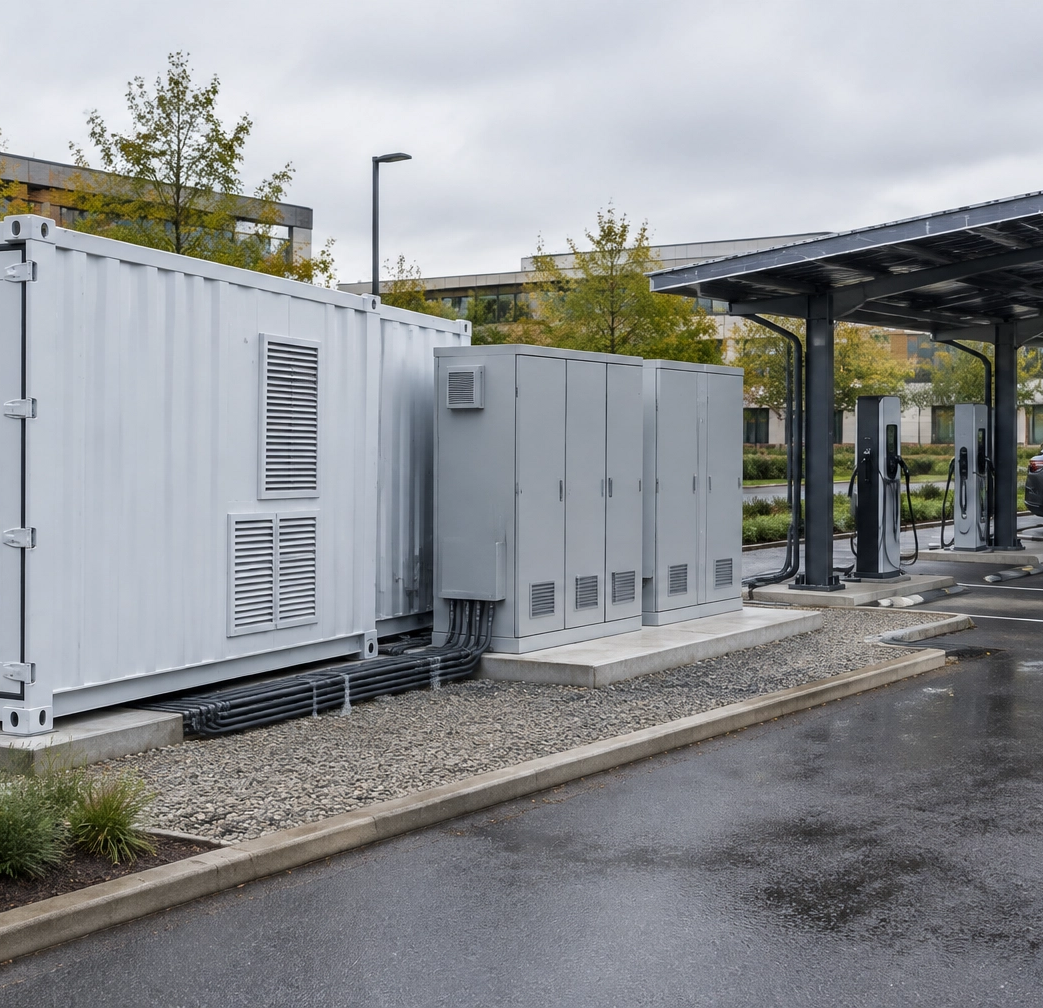
Illustrative image: battery storage and control equipment need their own carefully planned space.
What other property owners can learn
Aviva’s project offers three useful lessons. First, a car park may be an energy asset as well as a place to park. Second, solar, storage and EV charging are best assessed together, because their value depends on how generation and demand line up across the day. Third, this is a 2020 project: its published figures are original expectations, but its existence shows that a combined system of this kind was being delivered at commercial scale in Perth several years ago.
The reasons for investing can also go beyond energy costs. Aviva announced the project ahead of COP26 as part of its environmental commitments. For some organisations, sustainability goals and the visibility of action are material alongside energy resilience and the potential to use more electricity on site. The Perth scheme also benefited from public support, so its funding model is not a template every owner can assume will be available.
Nick Amin, then Aviva Chief Operating Officer, said:
> “It's vital that businesses in all industries put words into action when it comes to tackling the climate emergency. That's why we are taking strides to reduce our environmental impact and partner with leading technology specialists to help make that happen. The Perth solar and storage initiative is a great example of how Aviva is innovating to secure a sustainable energy supply and support the electric vehicle revolution.”
For commercial owners, the starting point is not simply counting parking bays. It is understanding the site’s electricity use, available space, grid connection, planning constraints and future charging needs.
Explore commercial solar for your site
Herofix was not involved in Aviva’s Perth installation and has no relationship with Aviva, RenEnergy or the Scottish Government. We do supply and fit commercial solar systems. If you are considering solar for a business property, learn about Herofix commercial services or get in touch to discuss your site.
Frequently asked questions
Aviva reported a 1.8 MWh energy storage system powered by Tesla Powerpack technology in its 2020 announcement.
Yes. Solar carports can be designed with EV chargers. A system needs suitable electrical capacity and controls to manage charging alongside the building’s demand, solar generation, battery and grid connection. Aviva reported 50 charging stations at its Perth site.