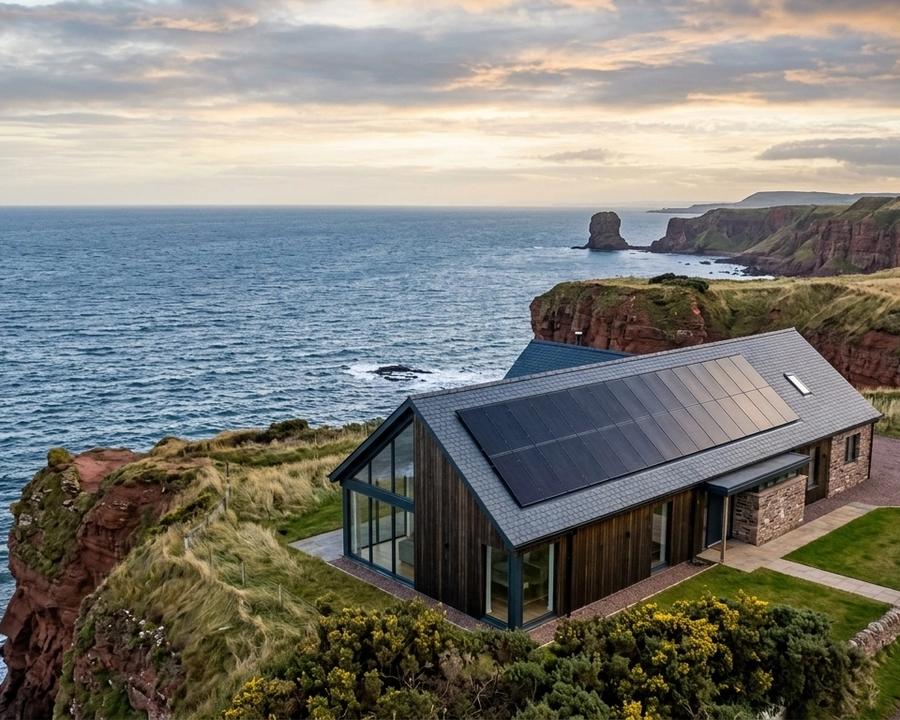
If you live in Arbroath, Montrose, or Broughty Ferry, you know the deal. The North Sea is a beautiful, moody neighbor. It provides us with world-class sunrises, the best haddock on the planet (talking about you, Arbroath Smokies!), and a constant, refreshing breeze.
But for your home’s exterior, that breeze carries a secret passenger: salt.
At Herofix, we love a coastal project. There’s something incredibly satisfying about watching a solar array soak up the bright, reflected light of the Tay. However, installing solar panels on the Tayside coast isn't the same as installing them in the middle of Perthshire. The "salt air" isn't just a poetic phrase; it’s a chemical reality that can turn a cheap solar installation into a rusty headache within a few short years.
In this guide, we’re diving into why "coastal resilience" matters and how we choose a robust solar kit specifically designed to survive the Tayside elements.
The Big Question: Do Solar Panels Rust Near the Sea?
It’s the first thing homeowners in Montrose or the "Ferry" ask us during a site visit.
The short answer: The glass and the silicon cells of the solar panel itself do not rust. However, the metal frames, the mounting brackets, the bolts, and the electrical connections absolutely can.
Salt mist is highly corrosive. It contains chlorides that love to eat through standard metals. If you use "standard" mounting gear: the kind of stuff designed for inland gardens: you’ll start to see "tea staining" (those ugly brown rust streaks) on your roof within 24 months. Left long enough, that corrosion can lead to structural failure. Not exactly what you want when a North Sea gale is blowing at 60mph.
At Herofix, we don't do "standard." We do coastal-ready.
The Science of Survival: IEC 61701
When you’re looking at solar panels for coastal homes in Scotland, there is one technical acronym you need to know: IEC 61701.
This is the international standard for salt mist corrosion testing. Panels are put into a chamber and blasted with concentrated salt spray at high temperatures to see how they hold up.
There are different levels of this test, ranging from 1 to 6.
- Level 1: Fine for inland areas like Forfar.
- Level 6: The "Gold Standard." This is designed specifically for marine environments where the panels are exposed to constant salt spray and high humidity.
The Herofix Standard: For our coastal customers in Arbroath and Montrose, we prioritise panels that have passed Severity Level 6. This ensures that the junction boxes are sealed tight and the frames have an extra-thick layer of protection to stop the salt from getting in.
Mounting Matters: The 316 Stainless Steel Secret
The panels get all the glory, but the mounting system is what keeps them on your roof. This is where many "national" installers cut corners to keep their prices low. They use 304-grade stainless steel or basic anodised aluminium without protection.
Here is the technical gap most people don't realize: 304 stainless steel vs. 316 stainless steel.
- 304 Stainless: Great for a kitchen sink. Not great for Arbroath. In a saltwater environment, 304 can develop rust pits in as little as three years because the salt prevents the metal's protective layer from "healing."
- 316 Stainless: This is the good stuff. It contains Molybdenum, a special element that makes the metal resistant to chlorides (salt). A 316-grade bolt can last 30+ years in coastal conditions without structural degradation.
When we install solar panels in Tayside's coastal zones (defined as anything within 5 miles of the shore), we insist on 316-grade stainless steel fixings. We also use EPDM gaskets and polymer washers to separate different types of metal. This prevents something called "galvanic corrosion": a fancy term for what happens when two different metals touch each other in salty air and one starts to "eat" the other.
Why Coastal Tayside is Secretly a Solar Goldmine
You might think that being on the chilly east coast of Scotland is a disadvantage for solar. Actually, it’s the opposite.
Arbroath and Broughty Ferry are among the sunniest spots in the country. Solar panels actually perform better in cooler, windier conditions because they don't overheat. The "Albedo effect" (light reflecting off the sea) can also give your panels a little extra boost in energy production.
Even on those "dreich" days when the haar rolls in from the North Sea, modern panels are incredibly efficient at capturing diffuse radiation (the light that makes it through the clouds). You’re still generating power; you're just doing it the Scottish way.
Keeping It Clean: Maintenance for Coastal Solar
One of the best things you can do for your coastal solar system is surprisingly simple: Give it a rinse.
While rain does a decent job of cleaning panels, salt can build up during dry, windy spells. Think of it like the salt crust on your windscreen after a drive along the A92. A quick hose-down with fresh water (no chemicals needed!) once or twice a year helps maintain maximum efficiency and keeps those 316-grade fixings looking pristine.
Adding the "Fix" to Your Energy: Batteries & More
Living on the coast often means being at the mercy of the weather. When the wind picks up and the grid gets a bit "jittery," having a home battery storage system paired with your solar can be a lifesaver.
At Herofix, we don't just "fit and forget." We design systems that integrate your solar panels with high-capacity batteries and even heat pumps. It’s about creating a "Hero-rated" home that is as resilient as the people who live in it.
Whether you’re in a modern villa in Broughty Ferry or a traditional cottage near the Montrose Basin, your home deserves an energy system that won't flake out when the salt starts flying.
Get Your 'Coastal Resilience' Assessment
Don't settle for a "one-size-fits-all" solar installation that wasn't built for the Tayside wind and salt. You need a local expert who knows the difference between a roof in Dundee and a roof in Arbroath.
We offer a specialized Coastal Resilience Assessment for homeowners in Arbroath, Montrose, Broughty Ferry, and surrounding areas. We’ll look at your roof orientation, wind exposure, and proximity to the sea to specify the exact kit you need to ensure your investment lasts for decades, not just years.
Ready to start your solar journey?
📧 Email us today at hello@herofix.com to book your assessment.
Or visit our homepage at www.herofix.com to see how we’re helping Tayside homeowners take control of their energy.
Herofix: Supplying and fitting solar panels, batteries, heat pumps, and boilers across Tayside and beyond. Simple, honest, and built to last.